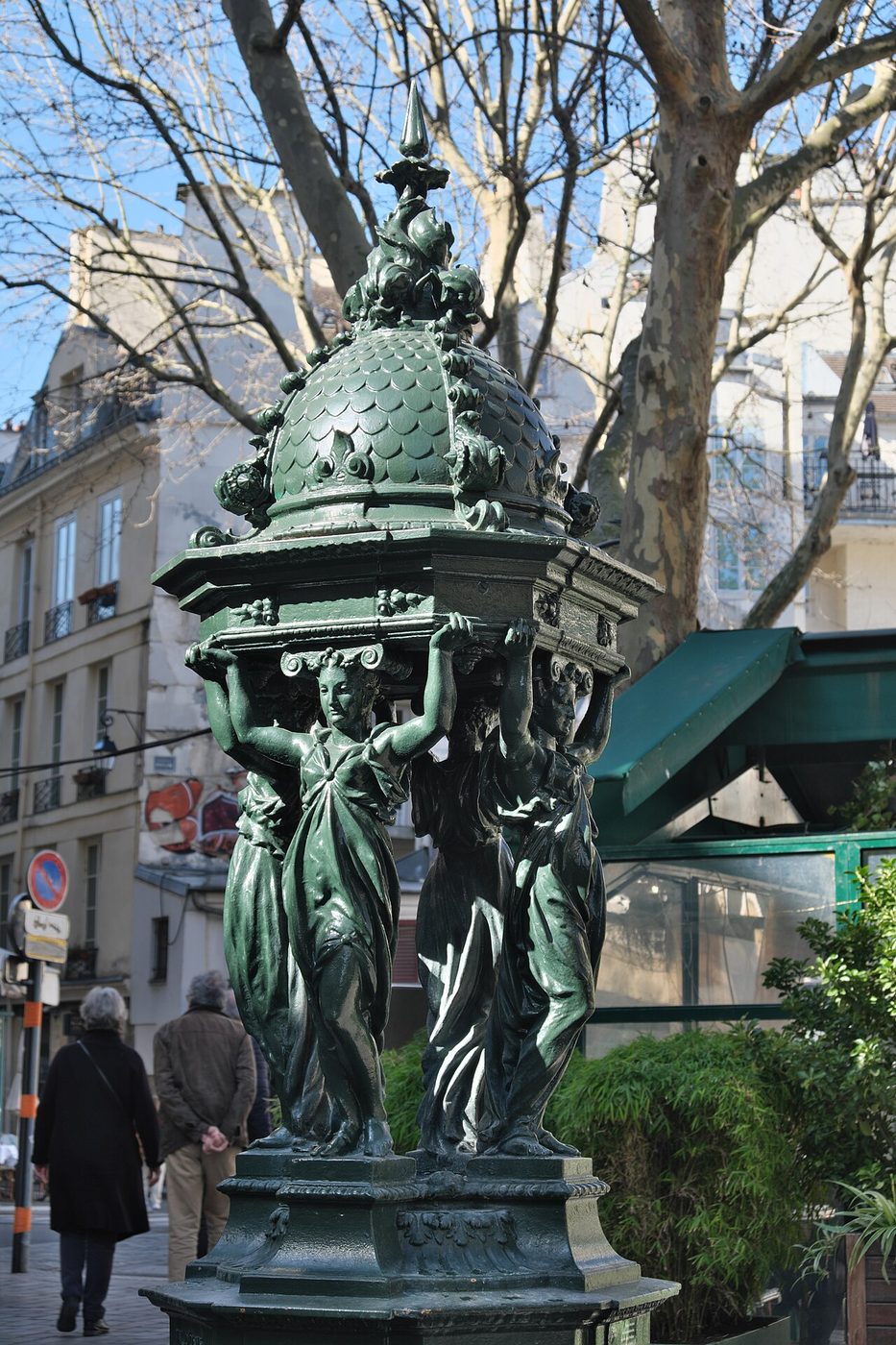
Two minutes from this door, four women in green cast iron are holding up a small dome. They have been standing there, holding it, since before the Eiffel Tower existed. Nobody looks at them. Everybody drinks from them.
I · The Winter Paris Drank Wine1870, and the taps ran dry
For four months the Prussian army sat in a ring around Paris and waited for it to give in. Inside the ring, two million people ate the carthorses, then the cats, then the elephants at the zoo. That part of the story gets told.
The part that gets forgotten is what happened to the water. The siege wrecked the aqueducts. Then came the Commune and the fires of the following spring, and by the time Paris started clearing the rubble in 1871, clean water had quietly become a commodity — carried in buckets, sold by the litre, and priced out of reach of the people who needed it most.
In the poor quarters of Paris that year, a litre of wine cost less than a litre of clean water. So people drank wine. Or they drank the Seine, which was worse.
II · The Man Who StayedRichard Wallace, 1818–1890
Almost everyone with money left Paris before the ring closed. Richard Wallace did not.
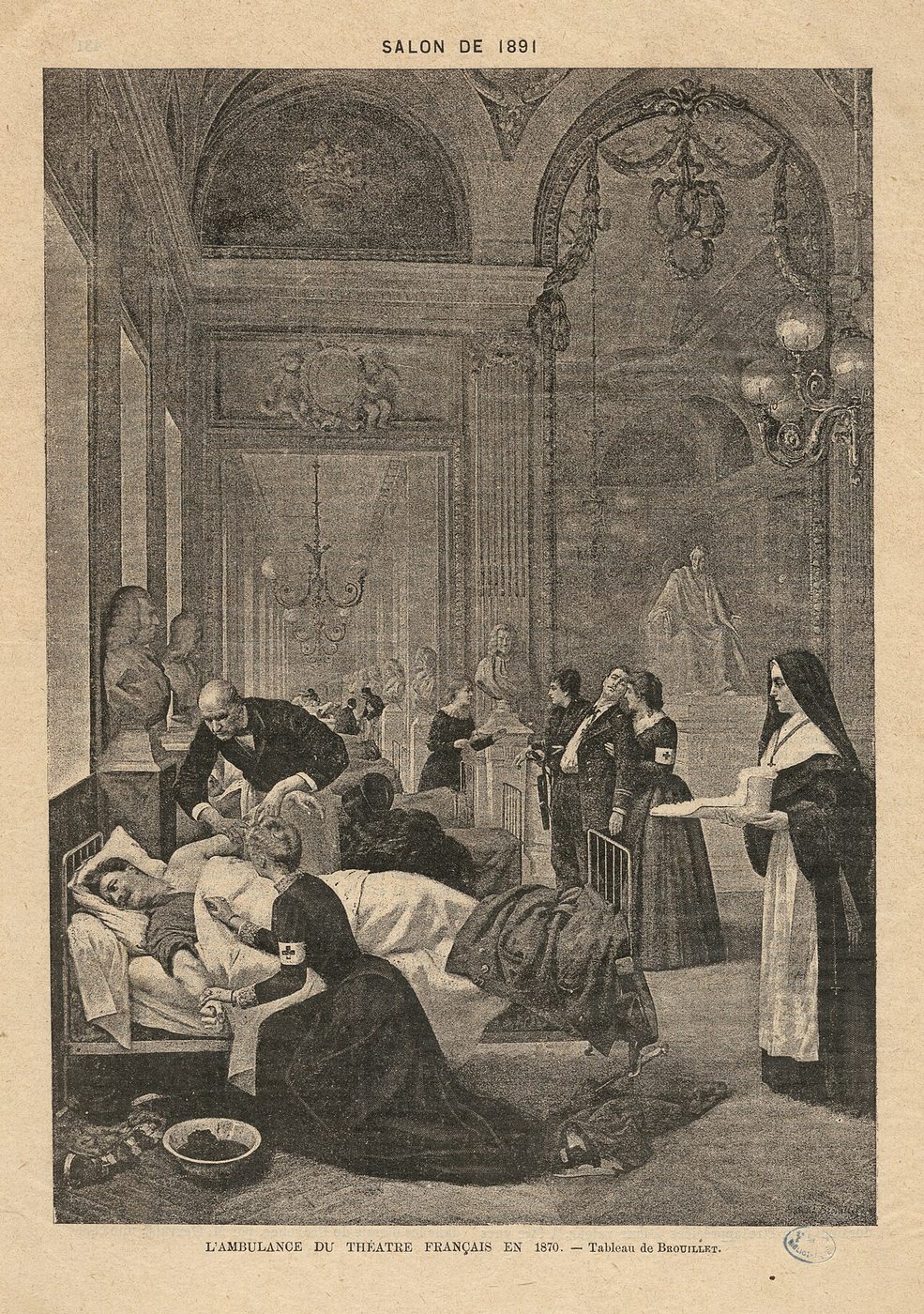
He was English, he was newly and enormously rich — he had inherited the year before — and he had spent his life slightly outside the society he moved in, because of the circumstances of his birth. He stayed in the city through the siege. He paid for field hospitals. He paid for food. He walked around a capital that was eating rats, and he watched the queues form wherever water could still be found.
When it was over, he did something that has outlasted every monument built by the men who fled.
III · Seventy FountainsThe gift, and what it weighed
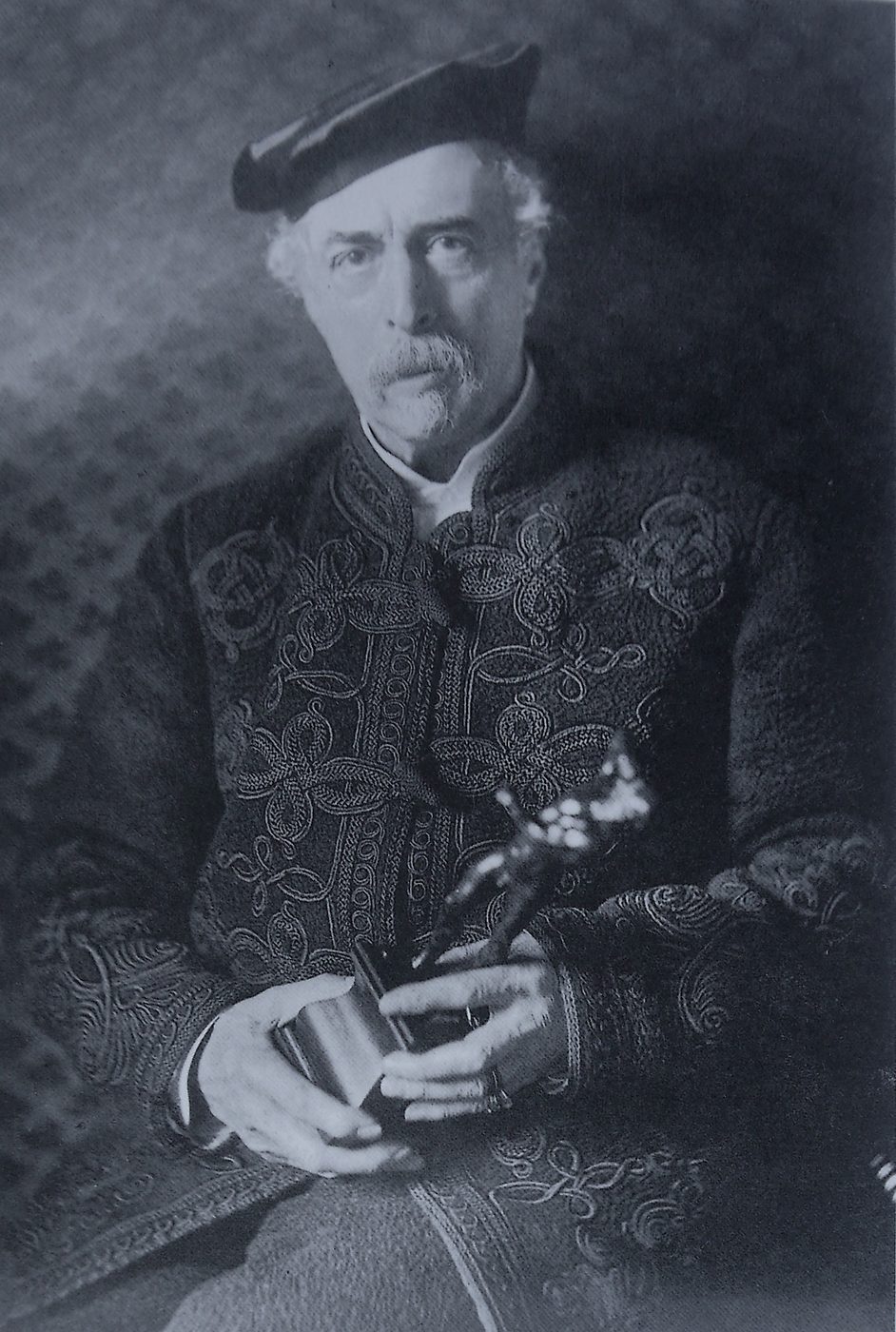
In 1872 Wallace gave the City of Paris fifty drinking fountains, paid for out of his own pocket. He added ten more in 1876, and ten more in 1879. Seventy in all.
He did not commission an architect. He sketched them himself, and handed the drawings to the sculptor Charles-Auguste Lebourg, who gave them their final form. Each one was cast in iron and weighs around six hundred kilos — the weight of a small horse, standing on a street corner, giving water away.
They were painted dark green for one reason: so they would disappear into the trees and the park benches and the rest of the city's ironwork. Wallace did not want them noticed. Parisians noticed anyway, and named them after him.
IV · Four Women, One ArgumentRead the fountain
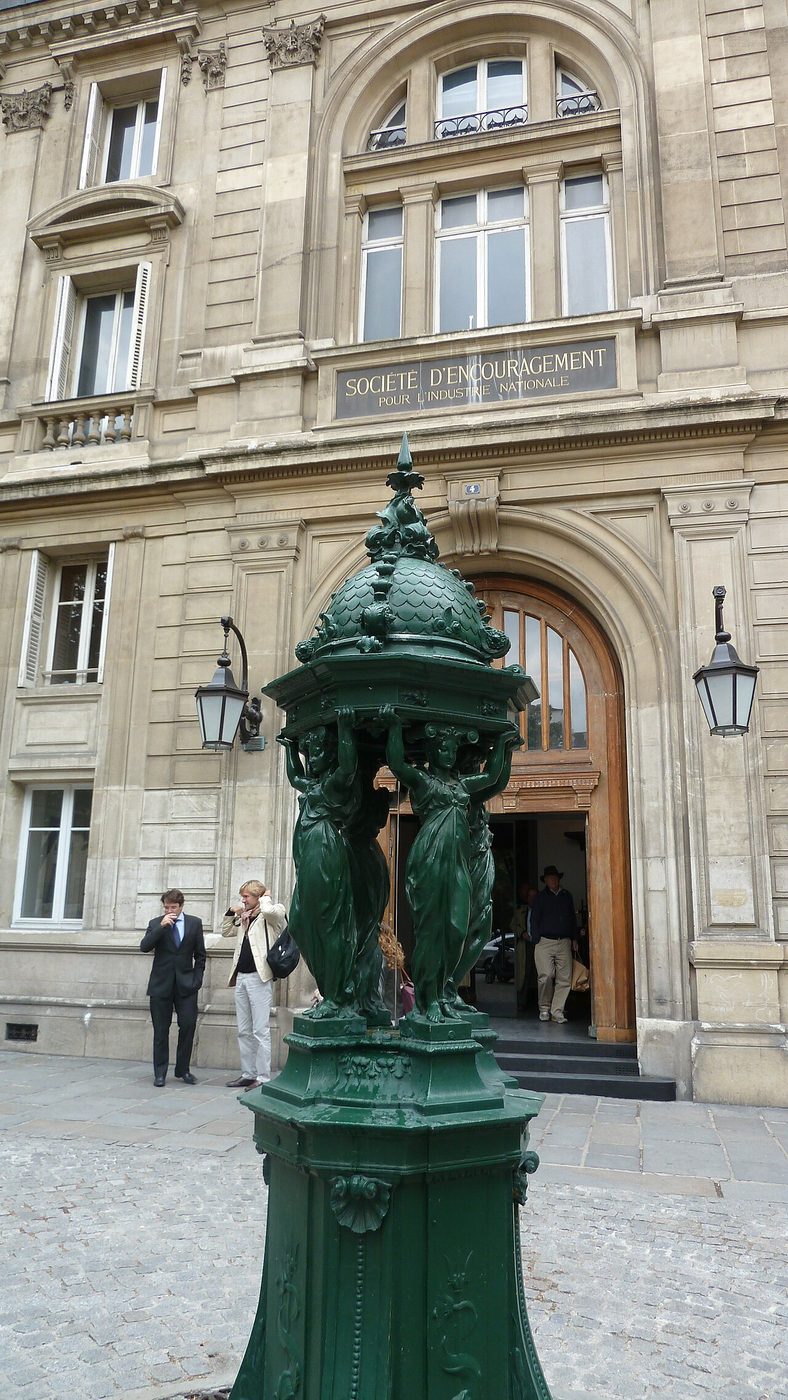
Stand in front of one and look up. Four caryatids stand back to back, arms raised, holding a scaled dome ringed with dolphins. At first glance they are identical. They are not — the knees are turned differently, the drapery falls differently, and each one has a name.
Simplicity. Kindness. Charity. Sobriety.
That fourth name is not decoration. It is the whole argument, cast in iron: clean water, free, on every corner, so that it is finally easier to reach than wine.
A public health policy, disguised as a piece of street furniture, disguised as four women holding up a roof.
V · The Cup on a ChainWhat Paris did with the gift
Every fountain came with two tin cups on little chains, so that anyone could drink on the spot. They stayed for eighty years, and were finally removed in 1952 for hygiene. Look closely at the ironwork and you can still find where they hung.
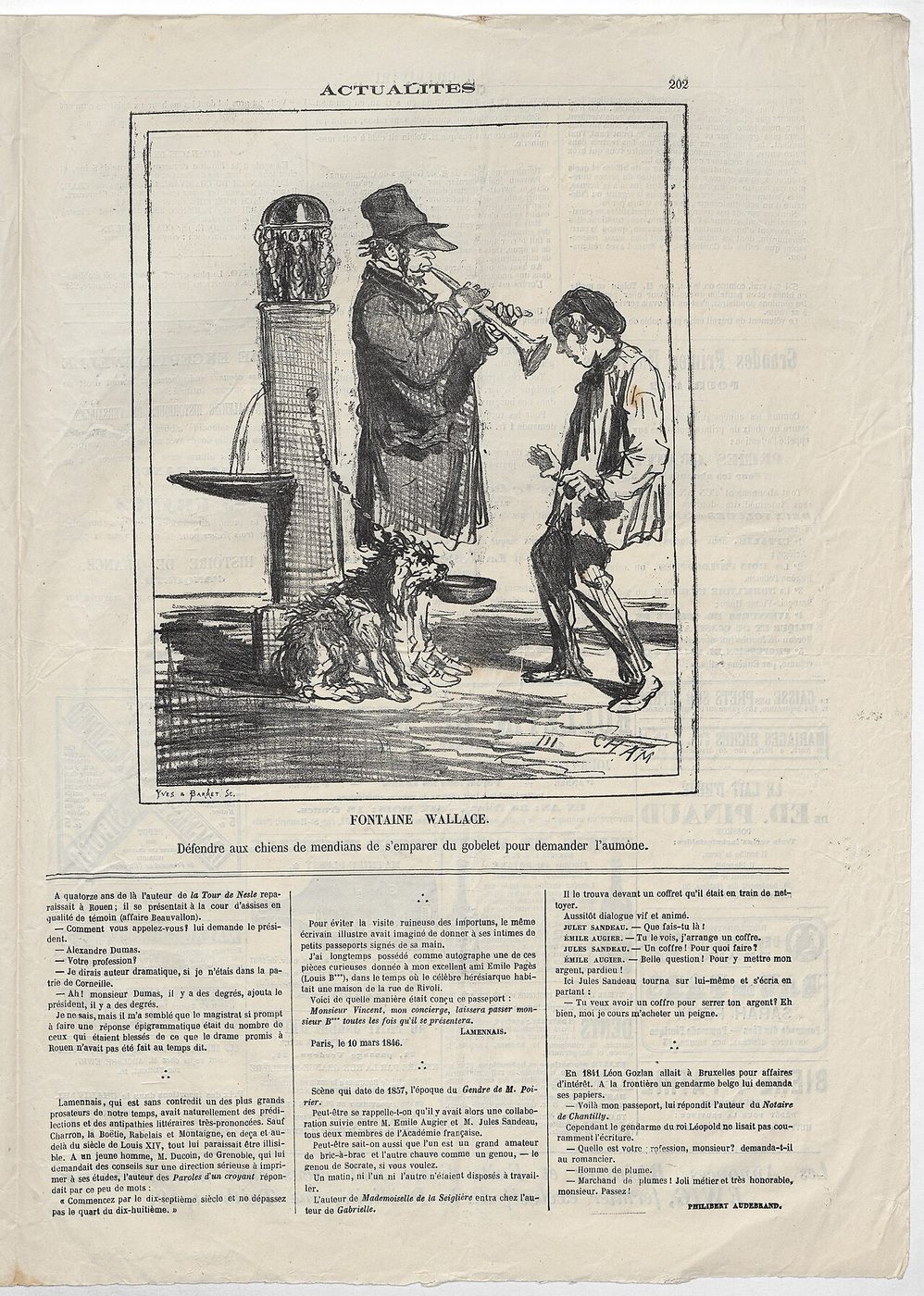
How fast did the fountains enter Parisian life? Here is the answer, drawn by the caricaturist Cham and printed in Le Charivari on 23 October 1872 — months, not years, after the first one was switched on. The joke is about beggars' dogs making off with the cup to collect alms. You cannot mock something that has not already become ordinary.
VI · Yours Is Two Minutes AwayThe map, and the exact walk
This is not a general fact about Paris. It is a specific fact about the street you are standing on.
From Studio Notre-Dame, at 23 quai Saint-Michel: cross to place Saint-André-des-Arts and there she is — a full caryatid model, running, free. 183 metres. Two minutes, less if you are thirsty.
From Studio Buci, at 13 rue de Buci: walk up to place Saint-Germain-des-Prés, in front of the oldest church in Paris and beside the terrace of Les Deux Magots. Same four women, same free water. 235 metres.
And if you turn east from the quay instead, toward Notre-Dame, you will find something Wallace never imagined: a Wallace fountain fitted with a misting head for heatwaves, on rue de la Bûcherie. It stands a few paces from a false acacia planted in 1601 — the oldest tree in Paris. A tree from Henri IV's reign, a fountain born out of the ruins of 1871, and a cooling device for summers nobody saw coming, all within thirty steps of one another.
Wallace fountain other drinking fountain our apartments

VII · They Sleep in WinterWhat nobody tells you
There are still 107 Wallace fountains in Paris, inside a wider network of roughly 1,200 public drinking fountains. All of it is free. All of it is drinkable. A few of them even serve sparkling water.
But from around mid-November until March they are switched off, so the pipes do not freeze. If you are here in the winter and find one dry, it is not broken. It is asleep, and it will be running again before the leaves come back.
VIII · Fill the BottleWhat you have actually rented
You are staying in a quarter where, inside living memory of the buildings around you, clean water was a luxury that killed people when they went without it.
Two minutes from your bed, a man who was born on the wrong side of a marriage, who stayed in a city everyone else fled, and who never put his name on anything, left you something to drink. He has been keeping that promise, without interruption, for a hundred and fifty-four years.
Take the empty bottle with you. Turn left. It costs nothing — which was, from the first day, entirely the point.
Studio Notre-Dame — 23 quai Saint-Michel
A room under the roof, facing the cathedral, on the Left Bank — and a Wallace fountain 183 metres away. Best price, booked direct — no middleman.
Book direct → homestay-france.comStudio Buci — 13 rue de Buci
In the heart of Saint-Germain-des-Prés, a market street at your door — and a Wallace fountain on the square. Best price, booked direct — no middleman.
Book direct → homestay-france.com