You came up the wrong staircase. Or rather — you came up the staircase that, for most of this building's life, you would not have been allowed to use.
I · Two StaircasesThe one at the back
Paris buildings of the nineteenth century were built with two staircases, and the difference between them was never about convenience.
The main stair was wide, made of stone, often carpeted, lit by a tall window on each landing. It belonged to the families who owned the apartments. The second stair was narrow, plain, usually wooden, tucked away at the back of the building. It was called the escalier de service — the service stair — and it existed for one reason only: so that the people who cooked, cleaned, carried coal up and ashes down could move through the building without ever crossing the path of the people who employed them.
That is the staircase you climbed with your suitcase.
II · The Vertical OrderA building you can read like a diagram
A Parisian building of that era can be read from the pavement upwards, and every Parisian still reads it instinctively.
The ground floor was for shops. Above them came the étage noble — the noble floor — low enough to climb comfortably in an age before lifts, high enough to escape the noise and the smell of the street. It had the tallest windows, the ironwork balcony, the plaster mouldings. That was where the money lived.
Then, floor by floor, the ceilings got lower and the tenants got poorer. And at the very top, under the roof slates, came the chambres de bonne — the maids' rooms. Seven, eight, nine square metres each. A skylight or a small dormer. No heating worth the name. Water on the landing. The lavatory on the landing too, shared between rooms.
You are on the sixth floor. The lavatory is still on the landing. That is not an unfinished renovation — it is a fossil, and it is the most honest surviving trace of what this room was built to be.
III · Who Slept HereThe woman with no name
We do not know her name. We know her job.
She would have been young — often sixteen or seventeen when she arrived, because nineteenth-century Paris ran on girls sent up from Brittany, Normandy and the Auvergne. She worked from before dawn until after the family had dined. She went up and down the back stairs perhaps thirty times a day, carrying water up and ashes down, and she was expected to be invisible while doing it.
And at night she climbed six floors to this room and closed the door on a view of Notre-Dame that today costs more for a single night than she earned in a season.
Nobody at the time thought that was remarkable. The view was worthless. It was worthless precisely because it was up here — six flights from the street, in a city where altitude meant poverty. Families with money stayed low, where the walking was easy.
IV · The ReversalHow the worst room became the best
Then came the lift, and then came the twentieth century, and the whole diagram turned upside down.
Once a machine did the climbing, the top floor stopped being a punishment and became a prize: light, silence, nobody walking above your head, and — on this particular quay — the cathedral. What had been the cheapest room in the building became the one people cross oceans for.
The maids' rooms of Paris became students' rooms, then artists' rooms, then apartments like this one. The hierarchy did not simply soften. It inverted completely. You are sleeping in the servants' quarters, and that is now the good address.
There is something quietly satisfying in that, and it is worth a thought while you stand at the window.
V · The View Came to the HouseA quay younger than the United States
Because the view itself has a history, and it is more recent than you would guess.
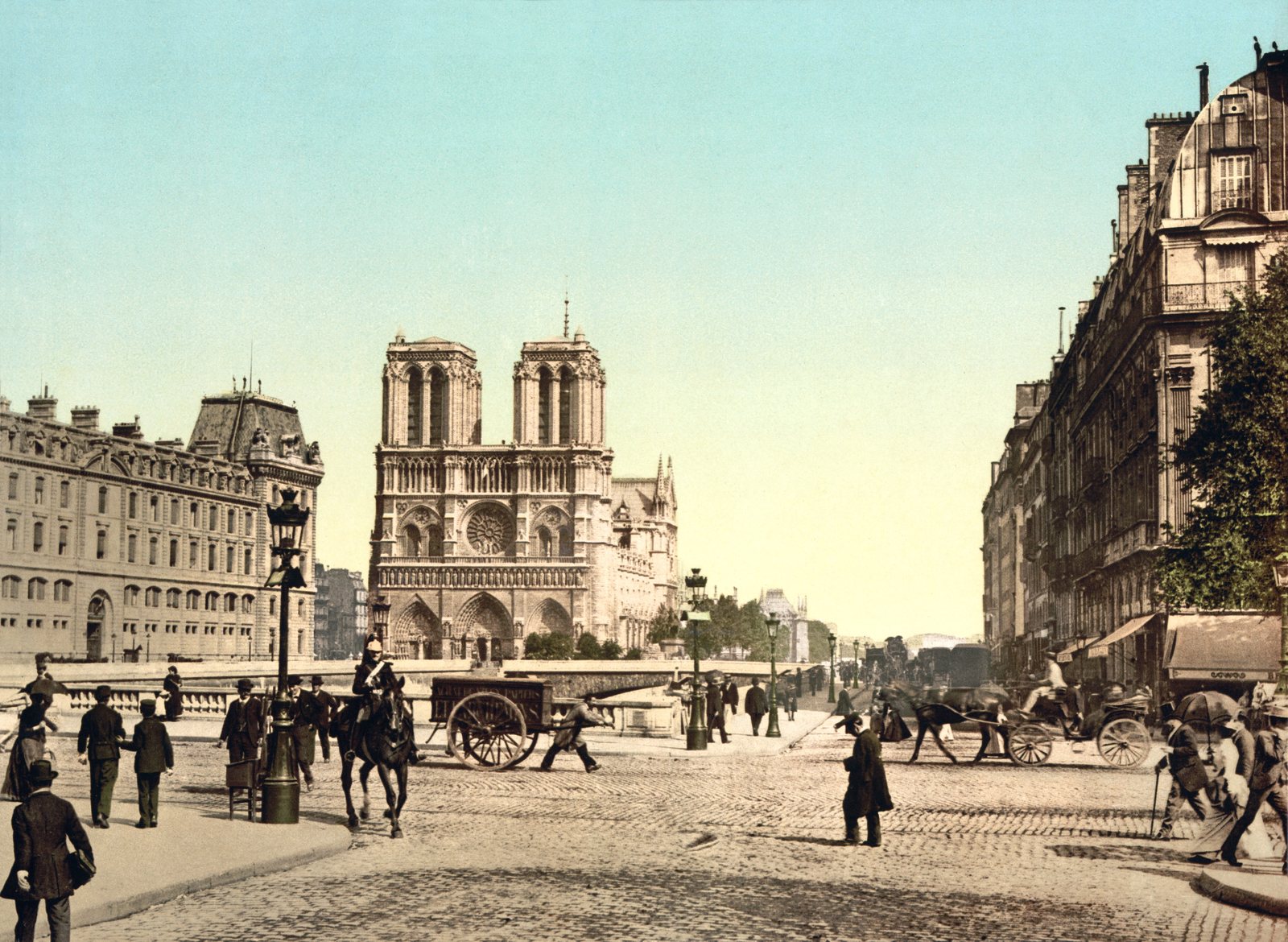
For most of its existence this stretch of riverbank had no quay at all. Houses stood directly in the water, their backs to the Seine, their cellars flooding every winter. The city laid a ceremonial first stone in 1561 — and then did nothing for two hundred years. It took royal letters patent in 1767 to force the decision, and the order was blunt: pull down the row of houses standing in the river. The embankment took another fifty years. The quai Saint-Michel opened in 1816.
Which means the houses of the second row — the ones that until then had faced a cramped lane and seen nothing at all — suddenly found themselves on a wide new quay, looking straight at Notre-Dame. They did not move. The view came to them.
You can still read it along the street. Four doors down, number 13 dates from 1763. At number 15 stands a house from the reign of Henri IV, four centuries old. This is not Baron Haussmann's Paris. It is the older, tighter fabric of the Huchette quarter that Haussmann found here and left alone.
VI · The DoorstepFour wooden crates, 1886
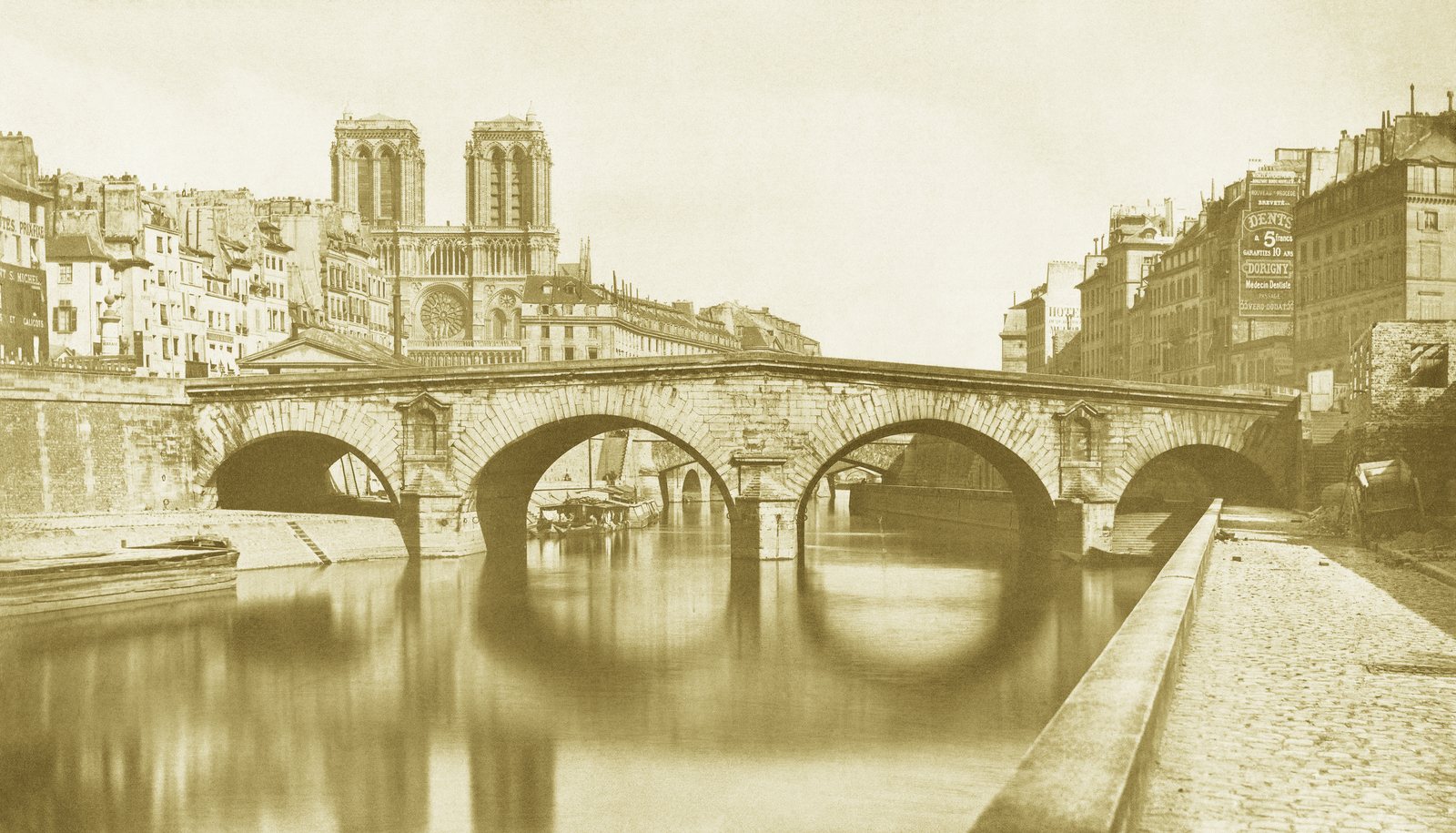
In 1886, a man set out four wooden crates on the river wall directly in front of this door.
His name was Joseph Gibert. Born in 1852 in a hamlet of the Haute-Loire, he had taught Latin and Greek at a school in Saint-Étienne before coming up to Paris in 1884. What he sold from those four boxes was not poetry. It was second-hand schoolbooks.
His timing was close to genius. France had just made schooling free and compulsory. Every family in the country suddenly needed textbooks and almost none could afford new ones — and Gibert was standing on a river wall in the middle of the student quarter, with the Sorbonne a few streets uphill.
Two years later, in 1888, he took premises in the building behind his crates. The first Librairie Gibert opened downstairs from this room.
He died in 1915, and his two sons divided the business between them; both halves are still trading today. The elder took the name up the hill to the boulevard Saint-Michel — Gibert Joseph. The younger, Régis, kept the original house on the quay, which from then on was known as Gibert Jeune, "Gibert the younger". Generations of Parisian students have bought their books under that name. It began with four boxes on the pavement you walked over to get here.
VII · Four Doors AwayThe painters at number 19
This quay was already a street of books before Gibert arrived: at number 19, Léon Vanier — the publisher who first put Verlaine into print — kept his shop from 1878 until his death in 1896.
And at that same number 19, Henri Matisse rented a studio from 1895 to 1907, on the third floor, returning to the fourth in 1913. The Notre-Dame paintings — the cathedral dissolved into a few strokes of blue and grey above the river — were painted from that window, thirty metres from yours. When Matisse gave the studio up in January 1908, Albert Marquet moved straight into it and went on painting the same water.
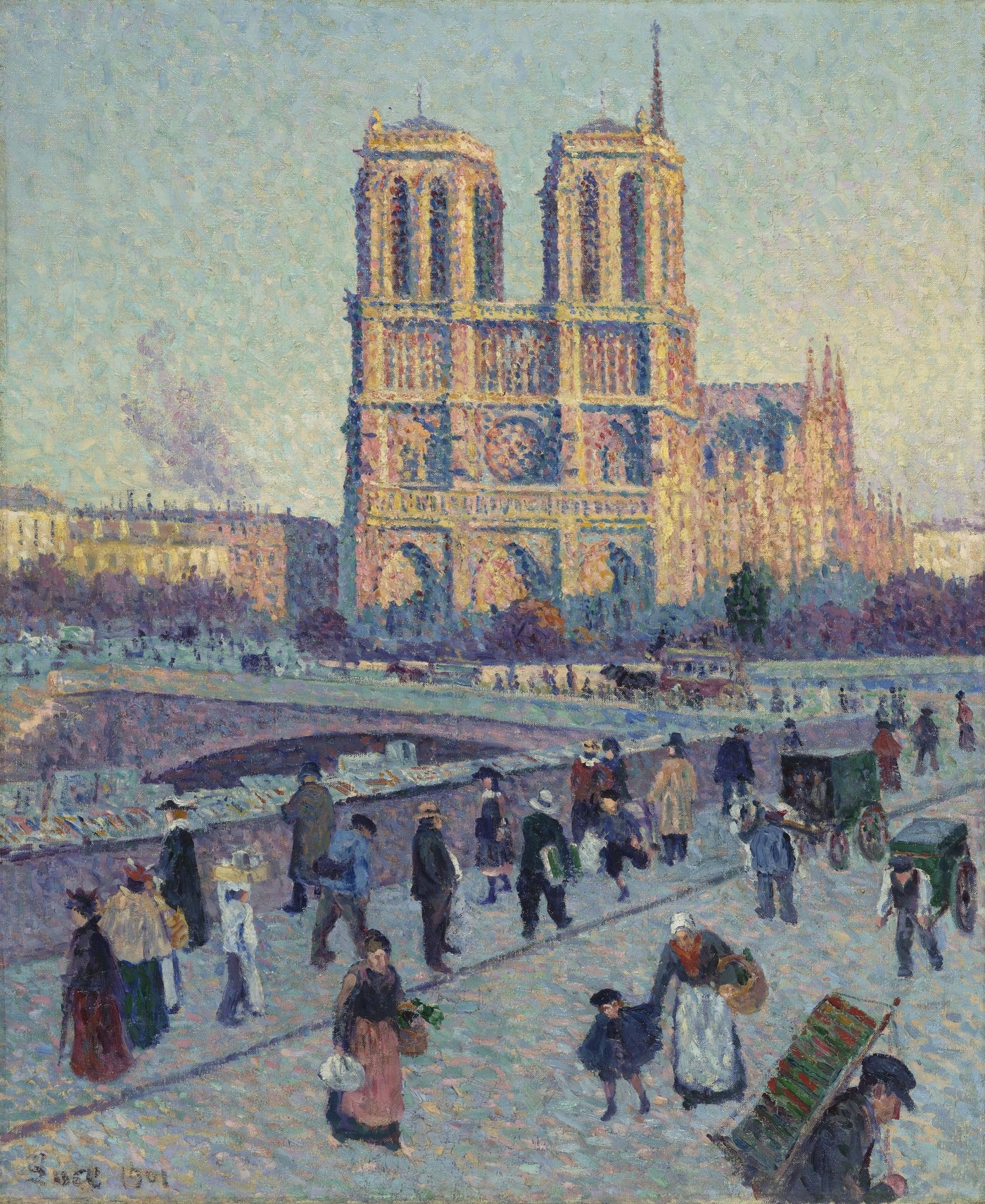
In 1901, Maximilien Luce painted the picture at the top of this page from almost exactly this angle — the booksellers' boxes open along the wall, the crowd on the pavement, the cathedral in the morning light. And in 1959, at number 15, Jean-Luc Godard set up a camera in a hotel room on this quay to shoot part of Breathless.
Then & NowThe same window, 114 years apart
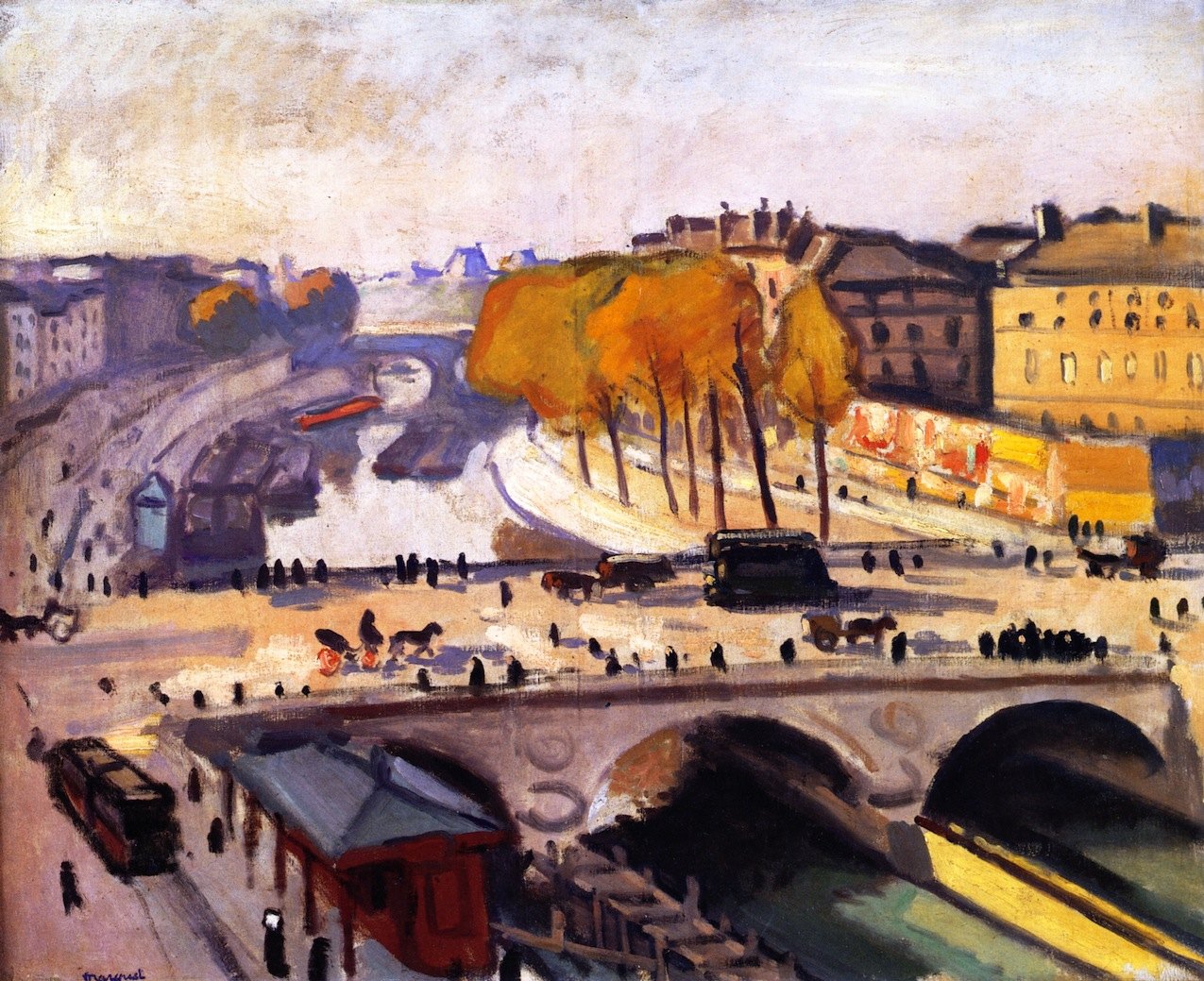
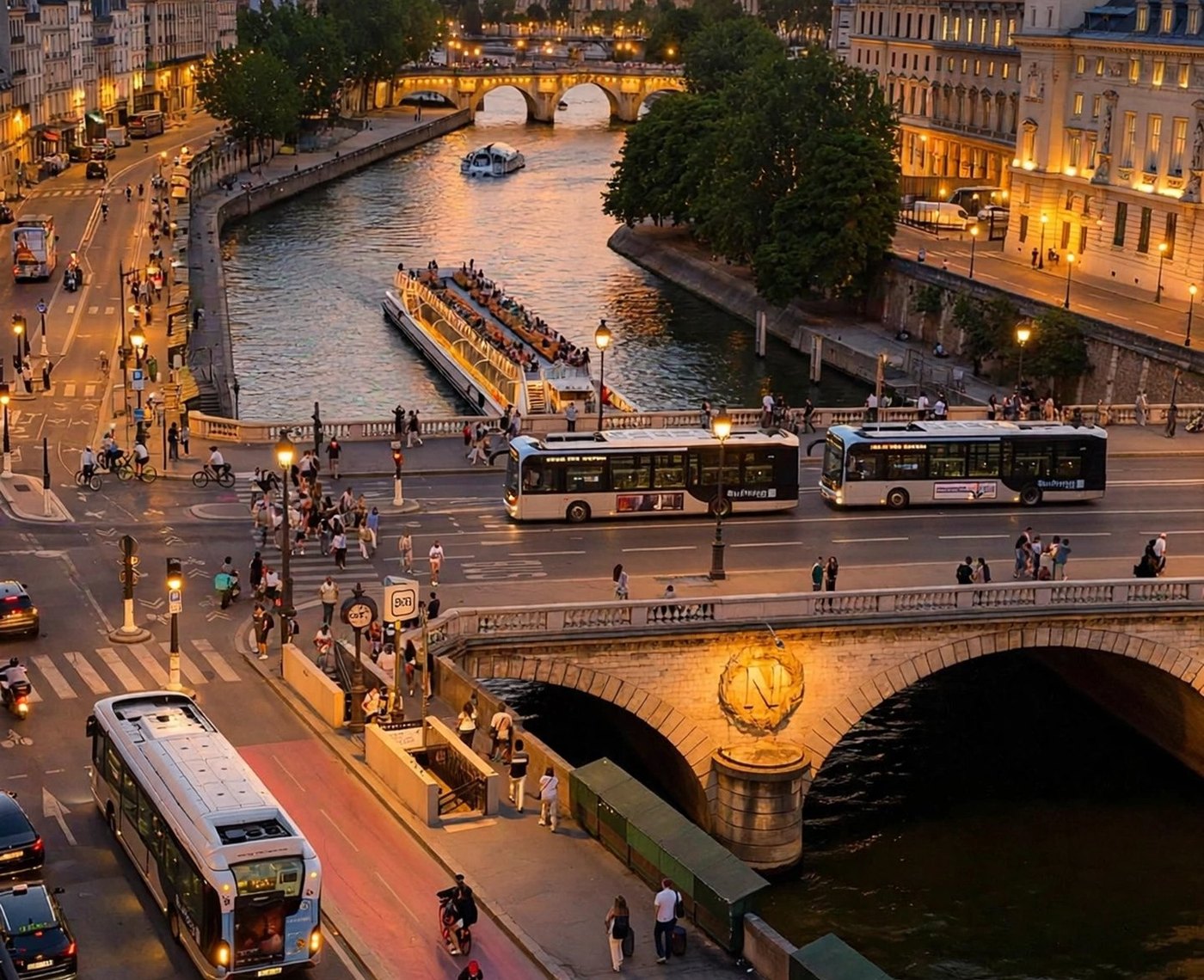
The arch of the bridge. Napoleon III's monogram carved into the stone. The little métro entrance below it. The quay curving away with its line of trees, and the Pont Neuf closing the distance. All of it still there. Marquet's tram has become two buses — otherwise nothing has moved.
VIII · Open the WindowWhat you have actually rented
None of these people lived in this room. They lived and worked within thirty metres of it, which on a quay a hundred and fifty-seven metres long is the same street, the same river light, and from the upper floors very nearly the same frame.
What you have rented is not a monument. It is a small room under the slates, built for someone who was never meant to enjoy it, on a quay that only has a view because a king ordered a row of houses knocked into the Seine, above a doorway where a country schoolteacher started a bookshop empire with four crates and a good idea.
The booksellers' green boxes are still on the wall outside. The stairs are still the servants' stairs.
Open the window.
Studio Notre-Dame — 23 quai Saint-Michel
A room under the roof, facing the cathedral, on the Left Bank. Best price, booked direct — no middleman.
Book direct → homestay-france.com